Monday, May 30, 2011

Aaron Copland


Aaron Copland was born on November 14, 1900 in Brooklyn as the youngest of five children.  His sisters taught him how to play the piano when he was eleven years old.  As a young man he went to France to study at the American Conservatory in Fontainebleau, where he studies with Nadia Boulanger.  He was inspired by Schoenberg, Bartok, Ravel, and Stravinsky.  In 1924 he completed his studies and returned to the U.S.

The 1920s and 1930s were a period of deep concern for Copland.  He worried about the limited audience for new, and especially American music.  He was active in many organizations devoted to performance and sponsorship of new music.  These included, the Copland-Sessions concerts, the American Composers’ Alliance, and the League of Composers.  His fellow composer Virgil Thomson nicknamed him “American music’s natural president.”

Beginning in the mid 1930s Copland made a serious effort to widen the audience for American music. He took steps by changing his style when writing pieces for different occasions.  He composed for theater, ballet, and films as well as more traditional concert settings.  In his ballet “Billy the Kid” (1938) he uses folk melodies to be broadly recognized as “American.” 

Copland’s concern for establishing a tradition of music in American life only increased throughout his life. He taught at Harvard and published several books.  He died in 1990.  He has been remembered as a man who encouraged composers to find their own voice, no matter the style, just as he did for sixty years. 

John Cage (1912-1992)


This is a composition by John Cage. He is, in my opinion, one of the most fascinating composers of all time.  He is mostly known for his composition called 4’33.” When performing  4’33” the pianist  sits at the piano closes the lid and doesn’t play for exactly four minutes and thirty-three seconds.  John Cage spent time in Europe as a young man and studied architecture and painting, but found he could not really devote his life to either. He returned to the U.S in the 1930s and studied composition with composer and music theorist Arnold Schoenberg.  After a while Schoenberg decided that Cage had no ear for harmony. He felt harmony was much more structural and less coloristic.  Schoenberg told him he would never be able to write music and when Cage asked why he said, “ You’ll come to a wall you won’t be able to get through.” Then I’ll spend the rest of my life knocking on that wall,” he replied.

In the 1930s he was considered a leader in avant-garde music.  He mostly composed pieces for percussion groups and for what was called “prepared piano.”  A prepared piano is a piano with various objects inserted between the strings for percussive effects (click on the link to watch someone prepare a piano, it’s insane!).  He used erasers, washers, screws, and whatever he had on hand.

He is known for pushing the boundaries of music and always referred to his career as “an exploration of non-intention.” Schoenberg hated all of his students and never said anything about any of them except for Cage.  “John Cage is not a composer, but an inventor of genius.”   


In the 1930's, particularly in the South, it was common place to punish criminals by placing them on chain gangs. As one can imagine, this involved manual labor, such as building roads, while the prisoners were chained to one another by the ankle. This practice was often accompanied by the "sweat box" a form a punishing an uncooperative inmate by placing him in a wooden, coffin-like box in the hot sun. In the thirties, this form of punishment was to be addressed in two major films, the drama I Am A Fugitive From a Chain Gang (1932), and the screwball comedy Sullivan's Travels (1941-not technically released in the 30's, but reflective of the decade).
I Am a Fugitive...was a particularly controversial film, as the state of Georgia sued Warner Brother's in an attempt to stop the film from being released. The film is based on the true story of a man wrongly accused and placed on a chain gang in Georgia. The man in question was actually still a fugitive, and served as a consultant on the film. The film is an scathing critique on an unfair judicial system, and established the studio as one of the most socially conscious of Hollywood.
Sullivan's Travels, a post-code, post-decade screwball comedy released by Paramount, can be seen to function as a kind of anti-Fugitive, in that it addresses the problem of life on the Chain Gang, but manages, as comedies often do, to reconcile itself to the prevailing ideology.

Art Deco


Art Deco was one of the most popular architectural styles of the 1930's, perhaps most famously and recognizably embodied by the Chrysler building in New York City, built over the years of 1928-1930. Other famous Art Deco style buildings are of course the Empire State Building and Rockefeller Center, both in New York. New York is not the only place where one can find great examples of Art Deco architecture, the Fisher Building of Detroit and the Kansas City Power and Light Building are both fine examples. However, perhaps one of the most beautiful and accessible places in America where one can find Art Deco style homes is the Art Deco district of Miami Beach.
As many of these landmarks were built, or in the process of being built, just before and after the crash of '29, one can see the spirit of American Exceptionalism embodied in such buildings as the Empire State Building, along with the other skyscrapers that were a testament to American ingenuity and muscle. It is an interesting coincidence that Ayn Rand's architecturally-themed book The Fountainhead (1943) began incubating within the author's mind around the same time, when Cecil B. DeMille commissioned her to write a script tentatively called Skyscraper.

Sunday, May 29, 2011

To The Paleofuture... And Beyond

As our comes to a close, I wanted to share with everyone my favorite article for the website Paleofuture. It discusses a Radio-Newspaper Receiver, that would transmit (and print out) the news for you to read at home. I love the idea of this device, because it suggests that people were thinking about the possibility of mass-communication, and how audio, text and image could someday merge in a way that would be available at home. Not only is it the Inter-Web-A-Tron of the day, but it seems to have inspired these ideas as well. Plus: I love the picture.

And, of course, this is where I have to sign off. It has been great to work with this class, and I really enjoy the subject matter. I think visions of the future is a good way to wrap things up. The '30's seems to be the source for so much of our lives now, and it is interesting to imagine where things will end up when people reflect on what life was like now. Hopefully some part of this class sticks with you in a meaningful way, and if you want to contact for in the future for any reason, I'll be there.

Be Seeing You.

I Just Can't Stop With The King Kong Talk

While the articles on King Kong were handed out in class, it was pointed out that not everyone got a copy of them. So I have them available here for download. They are pdf files, and contain a scan of the pages from The New York Times that these articles appeared in.


While I have already said just about everything I usually like to mention when I talked about King Kong in Mentor Session, I did want to direct curious readers to a wonderful oddity in the world of the 1930's: Wasei Kingu Kongu. This was a cheap Japanese copy of the film that was made after the initial American release of the film, as was the tradition at the time in Japan. While the film itself did not survive into the modern age (this frame is thought to come from the film), this American knock-off pre-figured the Japanese "Monster Movie" trend by almost 17 years. It is interesting that Godzilla and King Kong are often seen as the two "giants" in Monster Movie History, and yet Godzilla, it would seem, was really inspired by King Kong.

Wednesday, May 25, 2011

surrealism movement


Golden age
The Persistence of Memory (1931) by Salvador Dalí.Throughout the 1930s, Surrealism continued to become more visible to the public at large. A Surrealist group developed in Britain and, according to Breton, their 1936 London International Surrealist Exhibition was a high water mark of the period and became the model for international exhibitions.

Dalí and Magritte created the most widely recognized images of the movement. Dalí joined the group in 1929, and participated in the rapid establishment of the visual style between 1930 and 1935.

Surrealism as a visual movement had found a method: to expose psychological truth by stripping ordinary objects of their normal significance, in order to create a compelling image that was beyond ordinary formal organization, in order to evoke empathy from the viewer.

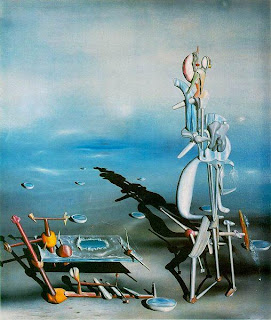
1931 was a year when several Surrealist painters produced works which marked turning points in their stylistic evolution: Magritte's Voice of Space (La Voix des airs)[23] is an example of this process, where three large spheres representing bells hang above a landscape. Another Surrealist landscape from this same year is Yves Tanguy's Promontory Palace (Palais promontoire), with its molten forms and liquid shapes. Liquid shapes became the trademark of Dalí, particularly in his The Persistence of Memory, which features the image of watches that sag as if they are melting.

The characteristics of this style—a combination of the depictive, the abstract, and the psychological—came to stand for the alienation which many people felt in the modern period, combined with the sense of reaching more deeply into the psyche, to be "made whole with one's individuality".

Between 1930 and 1933, the Surrealist Group in Paris issued the periodical Le Surrealisme au service de la revolution as the successor of La Révolution surréaliste.

From 1936 through 1938 Wolfgang Paalen, Gordon Onslow Ford, and Roberto Matta joined the group. Paalen contributed Fumage and Onslow Ford Coulage as new pictorial automatic techniques.

Long after personal, political and professional tensions fragmented the Surrealist group, Magritte and Dalí continued to define a visual program in the arts. This program reached beyond painting, to encompass photography as well, as can be seen from a Man Ray self portrait, whose use of assemblage influenced Robert Rauschenberg's collage boxes.


L'Ange du Foyer ou le Triomphe du Surréalisme (1937) by Max Ernst.During the 1930s Peggy Guggenheim, an important American art collector, married Max Ernst and began promoting work by other Surrealists such as Yves Tanguy and the British artist John Tunnard.

Major exhibitions in the 1930s

1936 - London International Surrealist Exhibition is organised in London by the art historian Herbert Read, with an introduction by André Breton.
1936 - Museum of Modern Art in New York shows the exhibition Fantastic Art, Dada and Surrealism.
1938 - A new International Surrealist Exhibition was held at the Beaux-arts Gallery, Paris, with more than 60 artists from different countries, and showed around 300 paintings, objects, collages, photographs and installations. The Surrealists wanted to create an exhibition which in itself would be a creative act and called on Marcel Duchamp to do so. At the exhibition's entrance he placed Salvador Dalí's Rainy Taxi[dead link] (an old taxi rigged to produce a steady drizzle of water down the inside of the windows, and a shark-headed creature in the driver's seat and a blond mannequin crawling with live snails in the back) greeted the patrons who were in full evening dress. Surrealist Street filled one side of the lobby with mannequins dressed by various Surrealists. He designed the main hall to seem like subterranean cave with 1,200 coal bags suspended from the ceiling over a coal brazier with a single light bulb which provided the only lighting,[24] so patrons were given flashlights with which to view the art. The floor was carpeted with dead leaves, ferns and grasses and the aroma of roasting coffee filled the air. Much to the Surrealists' satisfaction the exhibition scandalized the viewers.[6]